NGOGrant guide
APN CAPaBLE 2026: Up to US$40,000 for Climate Capacity-Building Projects
GRANT-143 · International grant · Climate and sustainability capacity building · India eligible · Not Indian CSR
Deadline: Monday 30 November 2026, 8:29 PM IST (11:59 PM Japan Standard Time). APNIS shuts automatically at that minute, so aim to submit by 29 November.
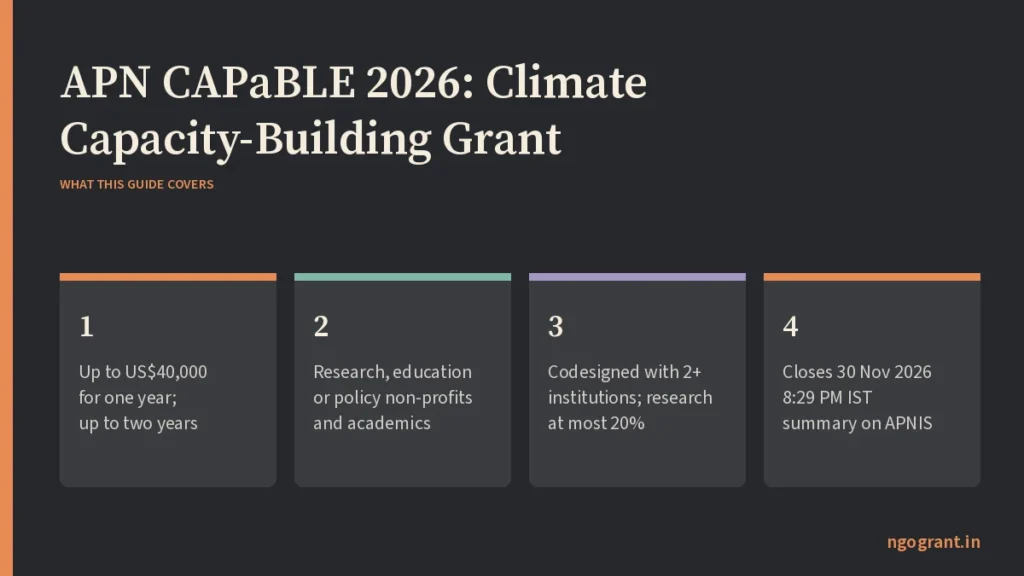
Short answer: APN offers up to US$40,000 for a one-year climate or sustainability capacity-building project. APN also considers projects of up to two years with a year-by-year budget and expected outcomes. The guide does not state a two-year funding cap. Indian non-profits that do research, education or policy work can apply, as can university and college academics. Consultants, private-sector staff, unaffiliated researchers and service-only NGOs should skip it. You need at least two institutions on the team, research kept to no more than 20% of the work, and a summary proposal entered online. Shortlisted teams hear by early March 2027.
CAPaBLE 2026 call on APNIS →Guide for proponents (PDF) →
Who is behind it
The Asia-Pacific Network for Global Change Research is an intergovernmental network: officials appointed by member governments, India’s among them, set its policy, and its secretariat sits in Kobe, Japan. CAPaBLE is the arm that trains people and institutions rather than paying for research.
Does your organisation qualify?
- Can lead: researchers or academics at a university, college or other academic institution, and researchers or practitioners at a non-profit, government body, museum, observatory, laboratory or professional society whose work involves research, education or policy analysis on global change or sustainable development.
- Collaborators must belong to an institution in an APN member or approved country. Students cannot be collaborators, though they can join as part-time research assistants.
- Early-career professionals get priority, whether they lead the proposal or make up most of the team.
A district NGO that runs programmes but publishes nothing, trains no one and advises no government will struggle here. A climate think-tank, an environmental education trust or a university department working with one is the natural fit.
What a CAPaBLE project looks like
The aim is to raise scientific capacity in developing countries at three levels: individuals, organisations or networks, and governance systems. In practice that means training courses, science–policy dialogues, toolkits and mentoring for early-career scientists, officials and practitioners. A project run entirely in India is allowed.
Codesign is compulsory. Stakeholders such as government departments, communities or civil society groups have to shape the proposal from the start, and APN screens for it at every stage.
Your proposal must also serve at least one international agenda, such as the Paris Agreement, the SDGs, the Sendai Framework or the Kunming–Montreal Global Biodiversity Framework, and pick one of the South Asia priority topics:
- Climate resilience, adaptation and climate-related losses and damages
- Nature-based solutions and ecosystem restoration
- Digital technologies and AI for Earth observation
- Food, water, energy and human security under climate change
- Governance, diverse knowledge systems and implementation gaps
The 16 November topic correction
On 16 November APN fixed errors in the South Asia priority-topic fields on APNIS and changed topic names to the format “Subregion acronym: Priority topic”. If you have already submitted a South Asia CAPaBLE proposal, APN asks you to withdraw and resubmit it with the corrected priority topic before the deadline. If you are still drafting, check your selection against the updated list before submitting; saved drafts may not update automatically.
What the money covers, and what it does not
A multi-year proposal needs a year-by-year budget with the outcomes expected at each stage. Funding for trainees and event participants is meant for early-career professionals. APN will not pay for:
- running costs of your institution, or taxes and statutory charges on the grant;
- salaries of administrative staff, or of researchers already on full-time pay;
- consultants;
- laptops, phones, office furniture, buildings or new departments;
- long-term observation or monitoring systems.
Cash or in-kind co-funding is strongly encouraged, and you must show proof of any outside money before APN signs a contract. Our project budget guide explains how to cost activities line by line, and the NGO Project Proposal and Budget Pack has editable templates.
FCRA: this is foreign money
An Indian NGO, trust or Section 8 company needs FCRA registration, or prior permission for this grant, before it can receive APN funds, and the money must come into its FCRA account. Universities and government bodies follow their own foreign-funding rules. Check your status now rather than after selection. The FCRA Act guide covers the rules, and the FCRA Readiness Checklist & Document Pack helps you gather the papers. General information, not legal advice.
Filling in the summary proposal
- Create an account on APNIS and complete your profile, including education, employment and publications. The CAPaBLE 2026 call only appears while it is open. Emailed proposals are not accepted.
- Enter the title, priority topic, thematic area, APN countries involved and SDG links.
- Write the summary, relevance to APN, objectives, expected outcomes, literature review, mode of operation and timeline in up to 1,500 characters each, and the methodology in up to 3,000. Check APN’s publication library first; proposals that repeat earlier work are rejected.
- Give the project length, a concise budget per year, cash and in-kind co-funding, and your APN award history.
- Save, then press Submit beside the draft. A saved draft is not a submission.
What happens after 30 November
Teams that pass Stage 1 are invited to submit a full proposal, with a detailed budget and a logical framework, by Monday 29 March 2027, 8:29 PM IST. Funded projects start from 1 October 2027.
The other APN call: CRRP 2026 offers up to US$45,000 by the same deadline, but needs at least three APN countries, two of them developing, so it rarely suits an Indian NGO. You can send only one proposal across CRRP and CAPaBLE this cycle.
For field projects on nature-based solutions, compare IKI Small Grants 2027; for conservation work, the Keidanren Nature Conservation Fund takes applications until 1 December 2026.
Common questions
Can we pay experts from Australia, Japan or other developed member countries?
Generally not under CAPaBLE. Experts from developed countries can take part as resource people or self-funded participants, but APN funds do not go to them. Their early-career professionals can be funded as trainees or event participants.
Do the codesign letters have to be ready by 30 November?
No. At this stage you describe how stakeholders shaped the proposal. Signed codesign confirmation letters from those stakeholders are a mandatory part of the full proposal, which only invited teams prepare.
Can a past APN project leader apply?
Yes, if the earlier project finished, or is due to finish, before 30 November 2026 and its reporting is complete by the full-proposal deadline. Leaders of ongoing APN projects cannot apply, and nor can a former leader who has received US$135,000 or more from APN in the past five years.
See the CAPaBLE directory entry or browse our funding opportunities. NGOGrant.in does not award grants and never charges a fee to approve or release one. Apply only through APNIS.
Important: NGOGrant.in does not award or guarantee grants. Free information and official links are always free. Any fees are only for documentation / proposal preparation help — never for “sanctioning” a grant. Beware anyone who takes money to guarantee funding.