NGOGrant guide
Biocodex Microbiota & Women’s Health Grant 2027: €200,000
GRANT-123 · International grant · Health · Women and girls · Research and innovation · Not Indian CSR
Short answer: The Biocodex Microbiota Foundation offers €200,000 in total for a research project of up to three years on male–female genital microbiome interactions and vaginal dysbiosis, including bacterial vaginosis. It is open worldwide, including India, to principal investigators with an MD, PhD or PharmD, but the money goes to their university, hospital or other research institution, never to individuals. Ordinary welfare NGOs are not suitable applicants. Email the official form by 15 January 2027 (“24:CET” as printed); our conversion is 16 January 2027, 4:30 AM IST.
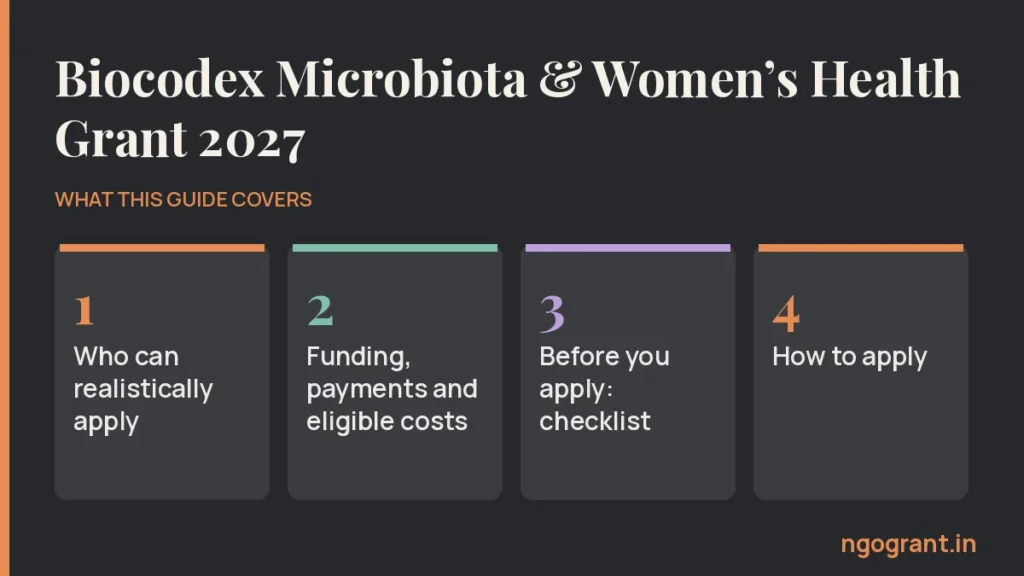
Apply through the official Biocodex Microbiota Foundation website. The official application form is a Word document on that site.
Time-zone note: The foundation prints the deadline as “January15th, 2027 (24:CET)” and its form says dates are in CET. We read this as midnight Central European Time (UTC+1) at the end of 15 January. The IST time in this article (16 January 2027, 4:30 AM IST, Asia/Calcutta) is our conversion, not a time printed by the foundation.
Looking for the gut microbiota call? The Biocodex Gut Microbiota Grant 2027 is a separate call on diet, the gut microbiome and immunity, with a 30 November 2026 (CET) deadline.
Practical answers: what does this grant fund?
This is a specialist biomedical research grant, not a general women’s welfare grant. The official call page sets the 2027 theme as “Unraveling male-female genital microbiome interactions: mechanisms, transmission, and impact on vaginal dysbiosis”. The theme is chosen each year by an International Scientific Committee, and either clinical or fundamental research proposals can be submitted.
The call says proposals could include, among other things:
- mechanistic studies of how the penile microbiome contributes to the establishment, persistence and recurrence of vaginal dysbiosis, including bacterial vaginosis;
- microbial transmission dynamics during sexual activity, and how bacterial vaginosis-associated bacteria adapt to and persist in the penile environment;
- the consequences of these interactions for the stability of the vaginal microbial community; and
- studies of how interventions such as antibiotics, topical or systemic partner therapies, circumcision or live biotherapeutic products change penile microbial ecology and, in turn, treatment response and recurrence risk in female partners.
Two limits apply. Projects related to sexually transmitted infections are not eligible, except bacterial vaginosis. Clinical studies may be submitted only after approval by an accredited ethics committee.
The official form describes the Biocodex Microbiota Foundation as a company foundation set up by the company Biocodex, with its headquarters in Gentilly, France. The call page says the International Scientific Committee is independent from the company. The foundation has run this women’s health grant since 2025.
Who can realistically apply?
The official call page and application form set these conditions:
- The principal investigator must hold a PhD, PharmD or MD and work in the subject area, for example gynaecology, obstetrics, microbiology, infectious diseases, internal medicine or oncology.
- There are no geographic restrictions: “All countries are eligible.”
- A principal investigator who has received a Women’s Health international grant from the foundation cannot apply for this award again for three years. Winners of the foundation’s other grant categories can apply.
- Members of the Women’s Health International Scientific Committee and members of their laboratories cannot apply as principal investigators.
- A single research department may submit only one project per grant. Partners from other institutions may submit a separate proposal.
The grant is not paid to individuals. The call page says it “will be awarded to researchers within universities, hospitals or other research settings” and “grants will not be awarded to individuals”. The form adds that the money is paid only to the institution where the principal investigator works, not to partner teams.
What this means for NGOs (our reading, not a statement by the foundation): a nonprofit hospital or research organisation with an established biomedical research setting, for example in gynaecology or microbiology, may fit “other research settings”, but the foundation does not say which types of Indian organisation qualify. Confirm in writing that your institution can host the grant before you prepare a proposal; the foundation’s contact page lists the official contact email. Ordinary welfare NGOs, including women’s welfare NGOs, without established biomedical research infrastructure and qualified investigators are not suitable applicants.
India, eligibility and receiving foreign funds
The call does not list countries and does not name India. Because it says all countries are eligible, researchers at Indian institutions are not excluded, subject to the conditions above, ethics approval for clinical work, the committee’s review and lawful receipt of foreign funds.
Foreign grant: Indian NGOs normally need FCRA registration or prior permission (FCRA 2010) to receive these funds. General information only, not legal advice.
Universities, hospitals and other host institutions should check their own route for accepting foreign funds before they sign. Our FCRA registration and prior-permission guide explains the general process.
Funding, payments and eligible costs
The call page says “The annual grant is set at €200,000” and that projects can last up to three years. The form makes clear that €200,000 is the total for the whole project, whether it lasts one, two or three years. We use the form’s wording: €200,000 in total, not per year.
You must budget for the full amount. The form says applicants “cannot ask for less than this amount”; a deviation of up to €1,000 below it is acceptable. The budget must list all items with a time frame for using the funds. If the project lasts more than one year, payment is made annually according to that provisional budget, on condition that the foundation receives annual interim reports.
According to the form:
- Eligible: personnel costs (only the share of time directly and exclusively spent on the project), lab supplies, consumables and equipment needed for the research.
- Overheads: must be in the budget and must not exceed 10% of the total grant (for example administrative staff salaries, office rent and common utilities).
- Not eligible: travel, congress expenses, accommodation expenses, and media or publication costs.
Present the budget in euros, as a table with a total. If the project is part of a larger project, the form asks you to state and justify any budget overlap; otherwise the application will not be evaluated. Our project budget guide can help you link each cost to the work plan.
Before you apply: checklist
- Confirm the principal investigator holds a PhD, PharmD or MD, has not received this grant in the last three years and is not a committee member or in a committee member’s laboratory.
- Check the project fits the male–female genital microbiome theme and is not an STI project (other than bacterial vaginosis).
- For clinical studies, obtain approval from an accredited ethics committee before you submit.
- Confirm your institution can receive and manage the grant, including the route for foreign funds.
- Check that no other project from the same research department is being submitted to this grant.
- List other funding received or requested for the project; the foundation must be told.
- Keep institutional registration and legal documents ready; our funding documents checklist helps organise them.
How to apply
- Read the full official call and rules on the official Biocodex Microbiota Foundation website.
- Download the official application form (Word) from that website and follow its instructions; the form says non-compliant applications will not be considered and unsolicited attachments are not accepted.
- Write in English, in Arial 10, within the limits: principal investigator CV (2 pages, as a separate file); confidential scientific summary (up to 1 page, including the institution’s name and organisational structure); non-confidential summary for the public (half a page on the form, published if selected); and a description of up to 6 pages (3 pages project description including title and acronym, 1 page references, 1 page budget and justification, 1 page schedule). The call page says applications that do not follow this description will be rejected.
- Email the completed form and attachments to the official application address listed on the foundation’s website with the subject line the form gives (“Microbiota & Women Health international grant – 2027”) by 15 January 2027, “24:CET” as printed by the foundation. Our conversion is 16 January 2027, 4:30 AM IST (Asia/Calcutta). Late applications will not be reviewed.
- Check that you receive the acknowledgement of receipt the foundation says it sends.
The call page also links an information notice on how the foundation processes applicants’ personal data. Use our proposal review checklist for a final read-through before you submit.
What happens next?
Each member of the Women’s Health International Scientific Committee evaluates the applications against: consistency with the theme, scientific quality, innovation, benefit for women’s health and disease, quality of the researcher(s), quality of the research environment and feasibility. Members with a possible conflict of interest do not review or vote on that project. The call page says decisions cannot be contested and do not have to be justified. The final decision will be made in May 2027.
The form says the closing date will not be extended. The call page also says that if there are not enough applications, the foundation may move the deadline to a later date or postpone the call, so check the official page before you submit.
If selected, you must send annual interim reports (for projects longer than one year) and a final report within six months of the project ending, acknowledge the foundation in publications, and allow it to publish your non-confidential summary. Our grant utilisation and reporting guide offers general preparation advice.
Common mistakes to avoid
- Treating this as a general women’s health or welfare grant for NGO programmes.
- Applying as an individual, or through an organisation without a biomedical research setting.
- Proposing an STI project other than bacterial vaginosis, or a clinical study without accredited ethics approval.
- Reading “annual grant” as €200,000 per year; the form says €200,000 for the whole project.
- Asking for less than €200,000 (more than €1,000 below), putting more than 10% into overheads, or budgeting for travel, conferences, accommodation or publication costs.
- Exceeding page limits, sending extra attachments, or missing the deadline by reading IST as the official time.
Frequently asked questions
Can an Indian NGO apply?
Only in a narrow sense. The grant is not awarded to individuals; it is paid to the institution where a qualified principal investigator (PhD, PharmD or MD) works, such as a university, hospital or other research setting. A nonprofit hospital or research organisation may fit, but the foundation does not confirm which Indian organisation types qualify, so confirm host eligibility first. Ordinary welfare NGOs without biomedical research infrastructure are not suitable applicants.
How much is the grant?
€200,000 in total for the whole project, whether it lasts one, two or three years, according to the official form. The call page calls it an annual grant of €200,000; it is not €200,000 per year. You must budget for the full amount; up to €1,000 below it is acceptable. Overheads cannot exceed 10%.
What research does the 2027 call want?
Research on male–female genital microbiome interactions: mechanisms, transmission and impact on vaginal dysbiosis, including bacterial vaginosis. Mechanistic studies of the penile microbiome and studies of interventions such as antibiotics, partner therapies, circumcision or live biotherapeutic products are encouraged. STI projects other than bacterial vaginosis are not eligible.
Do clinical studies need ethics approval?
Yes. The call page says clinical studies may be submitted only after approval by an accredited ethics committee. The form also asks you to attach any necessary ethics authorisation for human sample use.
What is the deadline in India?
The foundation prints the deadline as 15 January 2027 (24:CET). We read this as midnight Central European Time (UTC+1) at the end of 15 January, which is our conversion of 16 January 2027, 4:30 AM IST. Submit well before then. The final decision is expected in May 2027.
Browse the funding opportunities directory for other calls.
Last verified 10 November 2026 (IST, Asia/Calcutta). Selection is competitive and never guaranteed. The official call page and form mention no application fee. NGOGrant does not award these grants or charge approval fees. Use the official Biocodex Microbiota Foundation route, not an intermediary. Questions about the call should be sent through the official Biocodex Microbiota Foundation website.
Important: NGOGrant.in does not award or guarantee grants. Free information and official links are always free. Any fees are only for documentation / proposal preparation help — never for “sanctioning” a grant. Beware anyone who takes money to guarantee funding.