NGOGrant guide
GBIF DNA-Derived Data Pipelines Call 2026: Up to €20,000 per Project
GRANT-121 · International grant · Environment and Biodiversity · Research/Data Infrastructure · Not Indian CSR
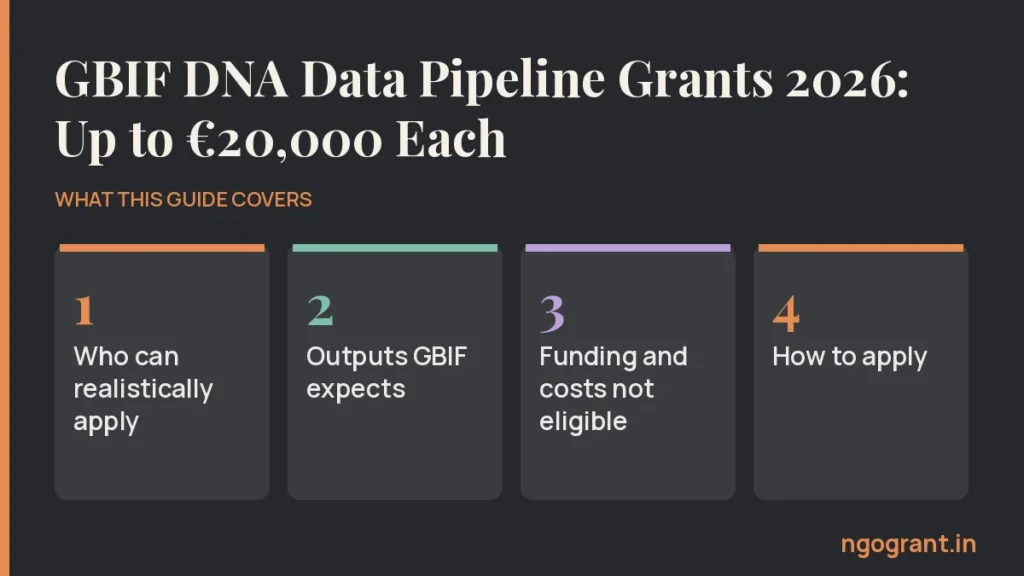
Short answer: The Global Biodiversity Information Facility (GBIF) offers up to €20,000 per project to build pipelines that publish and regularly update DNA-derived biodiversity data through GBIF. NGOs can apply, but only as legal entities that are already registered, endorsed GBIF data publishers, manage a large DNA or biodiversity data resource and can build the pipeline themselves. The deadline is 30 November 2026, 17:00 CET (UTC+1); our conversion is 9:30 PM IST (Asia/Calcutta) on the same date. Apply in English through the official form.
Time-zone note: All IST times in this article are our conversions from the official CET (UTC+1) deadline, not times printed in IST by the organiser.
Practical answers: what is this call actually funding?
This is a specialist technical call, not a general conservation grant. In the official call for proposals, GBIF invites proposals “for developing high-throughput publishing workflows that facilitate the sharing and regular updating of biodiversity data derived from DNA barcoding and metabarcoding through the GBIF network”. It welcomes organisations that manage large DNA-derived biodiversity datasets.
The money pays for building and documenting a data pipeline. It does not pay for new field surveys or new laboratory work. The call sits within SPLICE, GBIF’s project to integrate environmental DNA (eDNA) data into its infrastructure; GBIF says SPLICE is supported by the Novo Nordisk Foundation. GBIF posted this call on 22 October 2026.
GBIF ran an earlier call with the same title that closed on 3 August 2026, for projects starting in October 2026. The notice does not call the current call a second round. Rely only on the current notice for this call’s rules and dates.
Who can realistically apply?
The notice says applicants must:
- be a legal entity, “for example, research institution, university, museum, NGO or government agency”;
- be registered and endorsed as a GBIF data publisher, and have accepted the GBIF Data Publisher Agreement, at the time of applying or evaluation;
- manage a large DNA or biodiversity data resource that can be published through GBIF under an open CC0 1.0 or CC BY 4.0 licence; and
- have the technical capacity to design and implement data-sharing pipelines.
Taken together, these requirements point to organisations that already hold substantial DNA-derived data and have in-house data or software capacity. A conservation NGO without such a data resource, or one that is not yet a GBIF publisher, is unlikely to meet them for this deadline. This is our reading of the published criteria, not a statement by GBIF.
The work is done at your own premises. GBIF’s Secretariat gives remote technical guidance and review, “but not day-to-day development capacity”. Plan staff time for the build yourself.
India, eligibility and receiving foreign funds
The notice does not list eligible countries and does not name India. Indian organisations are included only by inference from the open legal-entity criteria, and remain subject to the GBIF publisher requirement, GBIF’s own checks and lawful receipt of foreign funds.
Foreign grant: Indian NGOs normally need FCRA registration or prior permission (FCRA 2010) to receive these funds. General information only, not legal advice.
Our FCRA registration and prior-permission guide explains the general process. Check your position before you commit to deliverables.
Outputs GBIF expects
Projects have up to eight months, with contracts expected to start on 1 March 2027. The notice lists two outputs:
- A technical specification, developed with the GBIF Secretariat, covering the data and metadata mapping strategy, mechanisms for updating data, a plan for long-term operation and maintenance, and interoperability, including persistent identifiers.
- Data publication: one or more datasets published through GBIF showing a substantial increase in DNA-derived records discoverable on GBIF.org, rich metadata, successful updates through the pipeline and, where relevant, interoperability or data improvements, for example links to sequence repositories.
Funding, payments and costs that are not eligible
The maximum is €20,000 per project. Payments are made in instalments linked to agreed deliverables. Selected projects take part in a start-up webinar (March 2027) and a mid-project meeting (June 2027). The notice does not state how many projects will be funded or a total budget.
The notice lists these costs as not eligible:
- overhead costs;
- bank fees;
- postal or courier service costs;
- compensation for exchange-rate losses;
- reimbursable tax;
- fieldwork or collection of new field data; and
- laboratory research to capture new data.
On tax, GBIF says that if your institution can have taxes reimbursed nationally they are not eligible; if they cannot be reimbursed, they are eligible. Because exchange-rate losses are excluded and the award is in euros, budget conservatively. Our project budget guide can help you tie each cost to a deliverable.
Before you apply: checklist
- Confirm your organisation is already a registered, endorsed GBIF data publisher and has accepted the Data Publisher Agreement.
- Confirm the dataset can be published under CC0 1.0 or CC BY 4.0 and that you have the right to publish it.
- Estimate the data volume (occurrence records and locations), taxonomic scope, metadata and expected update frequency.
- Name the staff who will build and maintain the pipeline after the eight months.
- Arrange partner letters of support where relevant, using GBIF’s model partner letter. If your organisation already participates in GBIF, obtain a statement of endorsement from the GBIF head of delegation or node manager; the notice links an endorsement template.
- Keep registration, legal and FCRA documents ready; our funding documents checklist helps organise them.
The partner-letter sentence in the notice is not entirely clear about when a letter is mandatory, and the endorsement link under “Proposal requirements” opens the partner-letter page rather than the endorsement template. If you are unsure which letters apply to you, ask GBIF at dna@gbif.org well before the deadline.
How to apply
- Read the full official GBIF notice, including outputs, non-eligible costs and evaluation criteria.
- Prepare a proposal covering what the notice asks for: a summary of your organisation and its data infrastructure; the data and its relevance to GBIF, including taxonomic scope; estimated volume; metadata scope; attribution and citation; expected update frequency and data growth; existing pipelines and planned improvements; technical approach and feasibility; support needed from GBIF; and a timeline (up to eight months) with costs (up to €20,000).
- Attach partner letters and any endorsement statement that applies.
- Submit in English through the official proposal form linked in the notice by 30 November 2026, 17:00 CET (UTC+1); our conversion is 9:30 PM IST (Asia/Calcutta).
Use our proposal review checklist for a final read-through before you submit.
What happens next?
GBIF Secretariat staff first screen proposals for eligibility, scope and relevance to SPLICE’s objectives. Eligible proposals are scored by independent reviewers and then evaluated by an expert selection panel, which also considers how well the data complements existing GBIF-mediated data. The criteria are relevance, impact (data volume and growth, metadata, attribution and licensing) and sustainability (feasibility, long-term workflow and interoperability). GBIF says selected applicants will be contacted after the review is complete; the notice gives no results date.
If selected, payment follows agreed deliverables, so plan records that show each milestone. Our grant utilisation and reporting guide offers general preparation advice.
Common mistakes to avoid
- Treating this as a general biodiversity or conservation grant.
- Applying before your organisation is a registered, endorsed GBIF data publisher.
- Budgeting for fieldwork, sampling, sequencing or other new laboratory work.
- Including overheads, bank charges or exchange-rate losses in the budget.
- Offering data under a licence other than CC0 1.0 or CC BY 4.0.
- Confusing the closed August 2026 call with this one, or reading IST as the official deadline time.
Frequently asked questions
Can an Indian NGO apply?
Possibly, but only a narrow group. The notice accepts legal entities, including NGOs, without naming eligible countries. The organisation must already be a registered and endorsed GBIF data publisher that has accepted the Data Publisher Agreement, manage a large DNA or biodiversity data resource and have the technical capacity to build data-sharing pipelines. India is included by inference, not as a named country.
How much funding is available and how is it paid?
Up to €20,000 per project, paid in instalments linked to agreed deliverables. GBIF does not state how many projects it will fund or a total budget. Selection is competitive and no applicant is guaranteed funding.
Which costs will GBIF not pay for?
Overheads, bank fees, postal or courier costs, exchange-rate losses, reimbursable tax, fieldwork or collecting new field data, and laboratory research to capture new data. Tax is eligible only if your institution cannot have it reimbursed nationally.
Do we need to be a GBIF data publisher before applying?
Yes. The notice requires applicants to be registered and endorsed as a GBIF data publisher, and to have accepted the GBIF Data Publisher Agreement, at the time of applying or evaluation.
What is the deadline in India?
The official deadline is 30 November 2026, 17:00 CET (UTC+1). Our conversion is 30 November 2026, 9:30 PM IST (Asia/Calcutta), the same calendar date. Submit well before then.
Browse the funding opportunities directory for other calls.
Last verified 16 November 2026 (IST, Asia/Calcutta). Selection is competitive and never guaranteed. The official notice mentions no application fee. NGOGrant does not award these grants or charge approval fees. Use the official GBIF route, not an intermediary. Questions about the call go to dna@gbif.org.
Important: NGOGrant.in does not award or guarantee grants. Free information and official links are always free. Any fees are only for documentation / proposal preparation help — never for “sanctioning” a grant. Beware anyone who takes money to guarantee funding.