NGOGrant guide
HawkWatch Global Raptor Research and Conservation Grant 2027: Up to US$3,500
GRANT-141 · International conservation research grant · Raptors · India eligible · Not Indian CSR
Deadline: 1 January 2027, 12:29 PM IST (31 December 2026, 11:59 PM Mountain Standard Time).
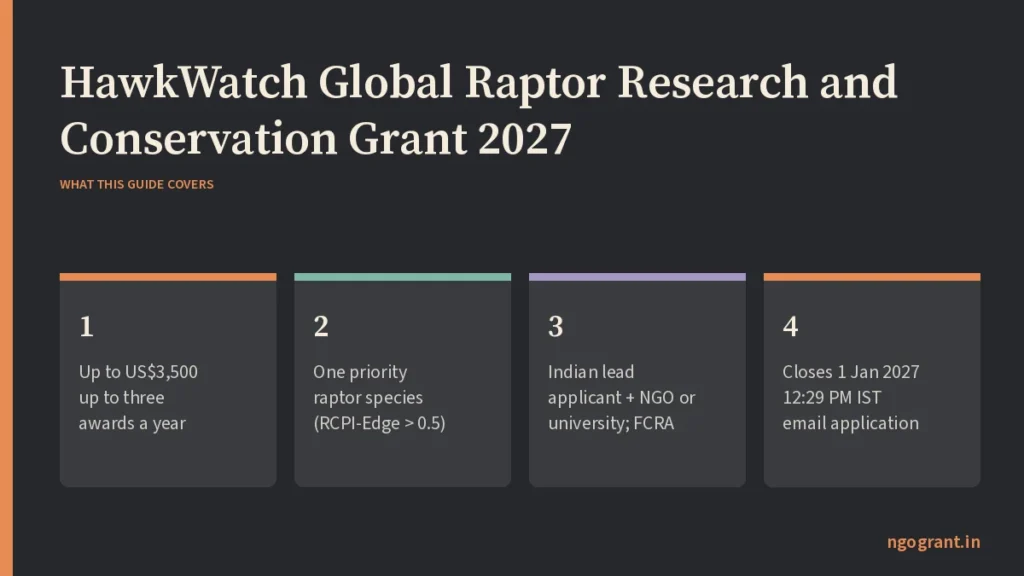
Short answer: HawkWatch International, a US raptor conservation nonprofit, gives up to US$3,500 to local researchers working on one of the world’s most threatened or least-studied birds of prey. Up to three projects are funded each year. Indian citizens can apply for work in India if a registered Indian NGO or university agrees to receive and pay out the grant. Indians have won in each of the last three rounds.
Application form (Word) →Official grant page →Priority species list (PDF) →
Which species qualify
The project must focus on a single raptor species with an RCPI-Edge score above 0.5 on HawkWatch’s 2025 priority list. The score combines IUCN threat status, evolutionary distinctiveness and how little research exists on the species; 158 raptors, about 28% of all species, make the cut.
Species found in India on the list include the Forest Owlet, Red-headed Vulture, Rufous-bellied Eagle, Great Nicobar Serpent-eagle, Andaman Serpent-eagle, Lesser Fish-eagle, Nicobar Sparrowhawk, Pallas’s Fish-eagle, Grey-headed Fish-eagle, Nicobar Scops-owl and Spot-bellied Eagle-owl. Check the exact score in the PDF before you plan around a species.
What the grant pays for
Either research that closes a knowledge gap or action that reduces a threat; a project need not do both, but it must show how it will improve the species’ conservation status.
- Research: diet, movement, breeding biology, habitat use or population dynamics. For species with little or no study, population and distribution surveys are encouraged.
- Applied conservation: human–wildlife conflict mitigation, habitat restoration, community-based conservation and education, or policy engagement.
Winners also get scientific guidance, networking and publicity for their results from HawkWatch.
Who can apply
- The applicant must lead the work and be a citizen or permanent resident of the country where it takes place. The application form itself asks for citizenship, so a permanent resident who is not a citizen should confirm eligibility with HawkWatch before applying.
- The applicant must be linked to a registered NGO or university in India that agrees to accept the grant and disburse it. If selected, you will need a letter of support from that organisation.
- Projects in the USA, Canada or Europe, outside the applicant’s own country, or that cannot finish all outputs within 18 months of receiving the money are not reviewed. Applications must be in English.
Past Indian awardees include Sunny Joshi (Pallas’s Fish-eagle, 2025), Kaushal Patel (Forest Owlet, 2024) and Arjun P. Kannan (Pied Harrier, 2023).
FCRA: who receives the money
Funds from HawkWatch are a foreign contribution. The Indian NGO or university that accepts the grant must be able to receive foreign contribution lawfully, which for most organisations means FCRA registration or prior permission from the Ministry of Home Affairs, with the money received in its designated FCRA account. Individual researchers should not take the grant personally; route it through the administering institution and confirm its FCRA position before asking for the support letter. Our FCRA Act guide covers the rules.
How applications are scored
HawkWatch scores the importance or impact of the project, the quality of the application and the applicant’s financial need. It prefers projects where the US$3,500 makes up at least half of the total budget, applicants with a proven or clearly committed path in raptor research, and species that have never been studied.
Preparing the application
- Download the application form and write in English, 12-point font, within each word limit: abstract 200, introduction 200, objectives 250, methods 500, conservation importance 150, outcomes 150, project team 200, and biography or motivation letter 500.
- Give the species’ IUCN Red List status, global population estimate with its source, and RCPI score; list permits needed and a timeline; name one referee who knows the field but is not part of the project.
- Show the budget in US dollars, including the total project cost and any co-funding.
- Insert the appendices into the same file: a project map, a CV of no more than two pages, a copy of your national ID or passport, and an optional photo. The form gives both four and five pages as the appendix limit, so keep to four.
- Email the single document to conservation.grant@hawkwatch.org before the deadline.
For another small conservation grant open to Indian groups, see the Crowder-Messersmith Conservation Fund 2027, which closes on 1 December 2026.
Common questions
Can a past grantee apply again?
Yes. A previous recipient who has met all reporting requirements can apply for one additional year of continuation funding. Himani Singh Khati received a continuation grant in 2024 for work on the Red-headed Vulture.
Does the project have to be part of a PhD or master’s degree?
No. The form only asks whether the work forms part of a university degree. Researchers based at an NGO can apply, provided the NGO or a university agrees to accept and pay out the grant.
Can the budget include overheads?
Yes, but institutional overhead is capped at 10% of the request. The form’s budget categories are permits, equipment, transport, meals, stipends and printing, each tagged to a purpose such as data collection, analysis, outreach or conservation action.
See the HawkWatch directory entry or browse our funding opportunities for other calls. NGOGrant does not award this grant or guarantee selection. Apply through HawkWatch International’s official route.
Important: NGOGrant.in does not award or guarantee grants. Free information and official links are always free. Any fees are only for documentation / proposal preparation help — never for “sanctioning” a grant. Beware anyone who takes money to guarantee funding.