NGOGrant guide
ICMR ANVESHAN and NISCHAYAK ANVESHAN 2027: Extramural Research Grants
GRANT-138 · Government of India research grants · Health research · India-wide · Not CSR
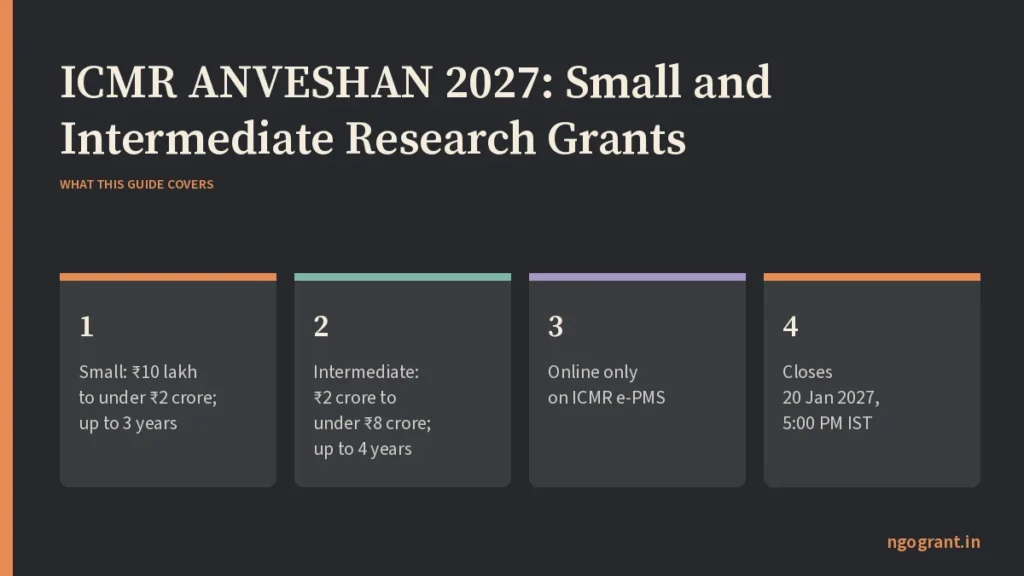
Short answer: The Indian Council of Medical Research (ICMR) has two 2027 calls for investigator-initiated health research: ICMR ANVESHAN (Small Extramural Grants, ₹10 lakh to less than ₹2 crore, up to three years) and ICMR NISCHAYAK ANVESHAN (Intermediate Extramural Grants, ₹2 crore to less than ₹8 crore, up to four years). Researchers at medical colleges, universities, research institutes, government bodies and recognised research NGOs anywhere in India can apply. Both close on 20 January 2027 at 5:00 PM IST, online only on ICMR e-PMS.
Small call notice (PDF) →Intermediate call notice (PDF) →ICMR e-PMS portal →
ANVESHAN vs NISCHAYAK ANVESHAN at a glance
| ICMR ANVESHAN (Small) | ICMR NISCHAYAK ANVESHAN (Intermediate) | |
|---|---|---|
| Budget per project | ₹10 lakh to less than ₹2 crore | ₹2 crore to less than ₹8 crore |
| Duration | Up to 3 years | Up to 4 years |
| Preparatory work | Up to 6 months within the proposal, at no extra cost | |
| Who can be PI | Same rules for both (see below) | |
| Review | Two independent experts score each proposal | Scored on the same 100-point scale |
| Suits | Projects that fit within ₹2 crore and three years | Larger projects that need ₹2 crore or more, or a fourth year |
| Deadline | 20 January 2027, 5:00 PM IST, on ICMR e-PMS only | |
Pick one. If similar projects go to both calls, ICMR will not review the Intermediate proposal.
Is this right for your NGO?
Only if your organisation does health research. These are ICMR extramural grants for scientists working outside ICMR’s own institutes. The money is for a defined research project with measurable objectives, not for running a clinic, a health camp or an awareness programme.
A community NGO without its own research team should not plan to lead an application. It can discuss a field or implementation role with an eligible research institution, which would need to agree the role under the grant rules. The Principal Investigator (PI) and the lead institution carry the scientific and financial responsibility.
Who can apply (both calls)
The PI must hold regular employment at an Indian medical institute, research institute, university, college, recognised R&D laboratory, government or semi-government organisation, or NGO, with documentary evidence of the organisation’s recognition (including a DSIR certificate where applicable). ICMR’s extramural research guidelines set the wider rules for host institutions.
Contractual or temporary faculty can be PI if the head of the institute takes full administrative and financial responsibility in writing, one Co-PI is a regular employee, and the PI draws no salary from the grant. In every case, at least one Co-PI must be from the PI’s own institute; CVs for the PI and up to three Co-PIs can be added.
- ICMR scientists and institutes cannot apply. They can be co-investigators, but no funds go to them.
- A PI cannot hold more than five ongoing ICMR projects, or ongoing ICMR grants above ₹25 crore in total.
- If a team submits similar projects within one call, only the last one submitted is reviewed.
Budget rules
Staff, equipment, consumables and contingency, travel and overheads follow ICMR project guidelines. Every item needs a detailed justification; ICMR says a proposal without it will not be considered for review.
What research qualifies
- Discovery: proof-of-concept and preclinical work, such as biomarkers, vaccine candidates, drug targets, organoids, devices and biosensors.
- Development: new or better tools for screening, diagnosis, prevention or treatment, including point-of-care tests, AI or machine-learning tools and clinical trials.
- Delivery or implementation: getting proven interventions to people through the health system and national programmes, with a clear intervention and stakeholder engagement throughout. This is the type most NGOs working with public health programmes will recognise.
- Descriptive: disease burden, risk factors and causes, where the evidence is needed for decisions.
Proposals on ICMR’s priority list get preference: communicable diseases (TB, malaria, antimicrobial resistance, HIV and other infections); non-communicable diseases (cancer, diabetes, heart and kidney disease, mental health, trauma and burns, blood disorders such as sickle cell disease); and reproductive, maternal and child health and nutrition (antenatal and postnatal care, preterm birth, neonatal sepsis, child malnutrition, anaemia, adolescent health). Cross-cutting areas include outbreak countermeasures, climate change and health, oral health, ageing, disability and rehabilitation, nursing and medical education; the Small call also lists physiotherapy. Topics outside the list can use the form’s “Other” option.
How proposals are scored
Out of 100: background and rationale (20), likely impact on health outcomes (20), novelty (15), methodology (30), implementation plan and milestones (15). A selection committee sets final scores and funds the top-ranked proposals in each priority area. Methodology carries the most weight, so study design, sample size and analysis plan matter more than a long background.
Part A must not identify the PI or institute, and the form asks whether and how you used AI tools to write the proposal.
Timeline
- Calls released: 6 November 2026 (notice No. ICMR/IDC/EPMS/CallforProposal/2026).
- Submission: 20 November 2026 to 20 January 2027, 5:00 PM IST.
- Review and selection: February to April 2027.
- Proposal improvement and final documents: May to July 2027 (tentative).
- Results: August 2027 (tentative).
How to apply
- Read the notice for your tier in full, including the proposal format and budget tables: Small or Intermediate.
- Log in to ICMR e-PMS and complete the mandatory PI profile sections.
- Go to Proposal submission, then Call for proposal, and choose either ICMR Small Extramural Grants (ICMR ANVESHAN Extramural Grants) 2027 or ICMR Intermediate Extramural Grants (ICMR NISCHAYAK ANVESHAN Extramural Grants) 2027.
- Submit before 20 January 2027, 5:00 PM IST, and keep your submission record.
ICMR noted that applications hosted at its headquarters may be unavailable on 21–22 November 2026 for maintenance; if e-PMS does not load then, try again afterwards. The portal’s Manual section has a user guide. Questions go by email: po.epms@icmr.gov.in for technical problems, sidhartha.g@icmr.gov.in for anything else about the calls.
Common questions
Can an NGO apply for ICMR ANVESHAN or NISCHAYAK ANVESHAN 2027?
Yes, if it is a recognised research organisation and the Principal Investigator is employed there. Every proposal needs documentary evidence of recognition, including a DSIR certificate where applicable. Both are research grants, not funding for routine programme work.
What is the difference between ICMR ANVESHAN and NISCHAYAK ANVESHAN?
ANVESHAN (Small Extramural Grants) funds projects of ₹10 lakh to less than ₹2 crore for up to three years. NISCHAYAK ANVESHAN (Intermediate Extramural Grants) funds projects of ₹2 crore to less than ₹8 crore for up to four years. Eligibility, deadline and portal are the same.
What is the last date for ICMR extramural grants 2027?
20 January 2027, 5:00 PM IST, for both calls. Submission is online only on ICMR e-PMS, which opened for these calls on 20 November 2026.
Can we send the same project to both calls?
No. If similar projects go to both, ICMR will not review the Intermediate proposal. Choose the call that matches your actual budget.
See the directory entry or browse other funding opportunities. NGOGrant does not award ICMR grants or charge for listings. Apply only through ICMR’s official portal.
Important: NGOGrant.in does not award or guarantee grants. Free information and official links are always free. Any fees are only for documentation / proposal preparation help — never for “sanctioning” a grant. Beware anyone who takes money to guarantee funding.