NGOGrant guide
ICMR SEHAT Mission EoIs 2026: Three Farm-Worker Health Research Calls (closed)
Closed. The last date for all three ICMR SEHAT EoIs was 20 Nov 2026; ICMR published no closing time. No extension was found when the official ICMR notice pages and PDFs were re-read on 21 Nov 2026 (IST). This page is kept as a record. For current calls, see our funding opportunities.
GRANT-130 · Government of India research EOI · Occupational and agricultural health · Specialist research call · Not CSR
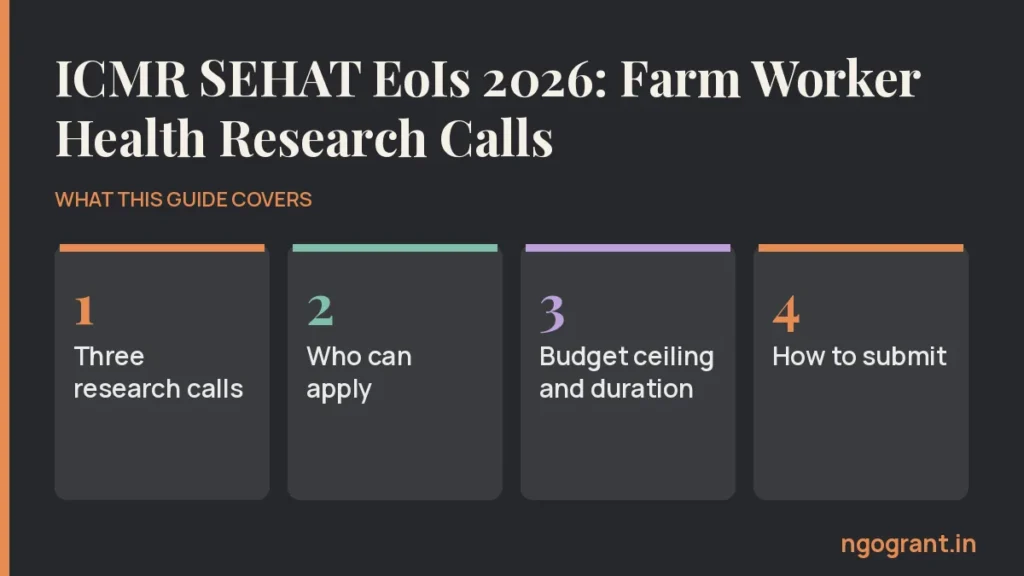
Short answer: The Indian Council of Medical Research (ICMR) is inviting Expressions of Interest (EoIs) for three research studies on the health of farm and allied-sector workers under the SEHAT Mission, which the notices describe as a joint national mission of ICMR and ICAR. The three topics are dust exposure among combine harvester workers, occupational biohazards among allied workers such as poultry, livestock and fisheries workers, and occupational pesticide exposure. This is a specialist research call: it is aimed at universities, medical colleges, research institutes and other eligible research organisations, and ordinary NGOs are not named as eligible. Each notice states a budget of “upto 8 crore” over 3 to 5 years; that is a ceiling, not a sanctioned grant. Submissions opened on 2 November 2026 and the last date is 20 November 2026, with no closing time published.
Official EoI: dust exposure (PDF) →Official EoI: biohazards (PDF) →Official EoI: pesticide exposure (PDF) →
Who should read this, and who should not
If your organisation is a university department, medical college, agricultural university, ICAR or CSIR institute, engineering institution or established research organisation working on occupational health, agriculture or public health, these EoIs are worth a close look. If you run a community NGO without a research team, ethics processes and laboratory or exposure-measurement capacity, you are unlikely to qualify as the lead applicant. The realistic route for such NGOs is to offer field access, worker outreach or implementation support to a research team that can apply.
ICMR’s own scientists cannot be Principal Investigator (PI) under these calls. They can join as co-investigators, but the notices say no funds will go to ICMR institutions or scientists in that case.
The three calls in plain terms
Each call has its own notice, topic and Google Form. They share the same duration, budget ceiling, eligibility wording and dates.
A. Reducing dust exposure among combine harvester workers
This call wants research that measures and cuts the dust that operators and helpers breathe during mechanised harvesting, and the lung and eye problems that follow. The notice suggests areas such as low-cost filtered enclosures for open operator platforms, dust control at source, better respiratory and eye protection for long, hot shifts, real-time dust sensors and training through Custom Hiring Centres and Krishi Vigyan Kendras. It specifically encourages studies across more than one state and several harvest seasons. Proposals mainly about crop-residue burning, ambient air pollution, or noise and heat without a dust component will not be considered. Official EoI PDF · Official Google Form
B. Preventing occupational biohazards among agricultural allied workers
This call covers workers in poultry, livestock and dairy, fishing and fish handling, aquaculture, animal markets, and slaughter and meat processing. ICMR wants practical, affordable and scalable interventions that interrupt a specific biological exposure pathway, for example through engineering, hygiene, sanitation, workplace design, behaviour change or digital training tools. Purely descriptive studies of prevalence or disease burden will not be prioritised. Official EoI PDF · Official Google Form
C. Integrated assessment of occupational pesticide exposure
This call asks for studies that assess how agricultural workers are exposed to pesticides and then test a structured intervention. The notice mentions pre- and post-intervention biomonitoring, tools to assess mixing, spraying, PPE use, storage and disposal, ergonomically designed sprayers, an AI-enabled smart spraying system and targeted training. The EoI must describe the team’s proficiency in artificial intelligence and machine learning methods suited to the study, so plan for that expertise from the start. Official EoI PDF · Official Google Form
Budget and duration: read the ₹8 crore figure carefully
Each notice says “Duration of the project: 3 to 5 years” and “Budget: upto 8 crore”. Treat the figure as the upper limit for a large, multi-year research project. The notices do not say how many projects ICMR will fund, how the budget is split by year or what costs are allowed. Nothing is sanctioned at the EoI stage. Build your EoI around the research question, not the ceiling.
What the EoI must contain
The notices ask for a brief EoI. Common items across the three calls are the title, the PI and collaborating investigators with affiliations, the intervention you propose, the rationale and existing evidence, the study design and methods, expected outcomes, public health relevance and potential for scale-up, and key references. Each call then adds its own items:
- Dust call: target crops, states or districts, harvest seasons and machine types; exposure and health assessment methods; the pathway from intervention to reduced exposure; and the farm-mechanisation partners involved.
- Biohazards call: the target allied-sector worker group, the biological hazard and exposure pathway, the gap the intervention fills, its novelty and any proof of concept.
- Pesticide call: methods to assess occupational and behavioural practices, intervention strategies, AI and machine learning proficiency, pre- and post-exposure assessment methods and the potential mechanism.
Our proposal review checklist helps with a final read-through, even for a short EoI.
How to submit
- Pick the one call that matches your research question and read its full official PDF.
- Confirm that your institution fits the eligibility list and that the PI is not an ICMR scientist.
- Draft the EoI against that call’s own list of contents.
- Submit through that call’s official Google Form by 20 November 2026. When we opened the forms, Google asked us to sign in first, so keep a Google account ready and do not leave submission to the last hour. We could not view the form questions.
The notices give one contact for enquiries: Dr. Swati Allen, Scientist C, at missionsehat.icmr@gmail.com, as printed in all three PDFs.
What happens next
ICMR reviews the EoIs; the dust and pesticide notices say a Technical Advisory Group constituted by ICMR does this. Criteria include scientific merit, novelty, feasibility, potential public health impact, strength of multidisciplinary partnerships and alignment with the SEHAT Mission. Shortlisted applicants may be invited to develop a detailed research proposal, and only shortlisted PIs are contacted by email. For the dust call, ICMR may also link shortlisted teams with complementary skills into a joint multi-centre proposal.
Common mistakes to avoid
- Reading “upto 8 crore” as money on offer to every applicant.
- Applying as a community NGO with no research capacity, instead of partnering with an eligible institution.
- Sending a descriptive survey when the call asks for an intervention.
- Sending one proposal to the wrong call’s form.
- Waiting until late on 20 November when no closing time is published.
For other research funding, see the ANRF PM Early Career Research Grant listing, or our guide to government grants versus CSR funding.
Frequently asked questions
Can an ordinary NGO apply for the ICMR SEHAT EoIs?
Not on the published wording. The notices invite researchers and institutions such as ICAR and CSIR institutes, DBT-supported institutions, universities, medical colleges, agricultural universities, engineering and technical institutions, public research institutions and “other eligible research organisations”. NGOs are not named. A non-profit with a genuine research set-up should ask ICMR before applying; a field NGO is better placed as a partner in a team led by an eligible institution.
Is ₹8 crore a grant amount?
No. Each notice says “Budget: upto 8 crore”. That is a ceiling for a 3 to 5 year research project, not a sanctioned or guaranteed amount. The notices do not say how many projects will be funded, and an EoI is only the first stage.
What is the last date and time?
Each notice gives an end date of 20 November 2026, and ICMR’s announcements list the same date. No closing time is published. Do not assume midnight; submit well before the end of the day.
Can one team apply to more than one of the three calls?
The notices do not address this. Each call has its own topic, PDF and Google Form, so a proposal must fit the call it is sent to. If you want to submit to more than one, ask ICMR at the contact address printed in the notices.
What happens after the EoI?
ICMR reviews the EoIs (the dust and pesticide notices name a Technical Advisory Group). Shortlisted applicants may be invited to develop a detailed proposal, and only shortlisted PIs are contacted by email.
Browse the funding opportunities directory for other calls.
Last verified 16 November 2026 (IST, Asia/Calcutta) against the three ICMR notices and ICMR’s announcement list. Selection is competitive and never guaranteed. The notices mention no application fee. NGOGrant does not award these grants or charge approval fees. Use the official ICMR route, not an intermediary.
Important: NGOGrant.in does not award or guarantee grants. Free information and official links are always free. Any fees are only for documentation / proposal preparation help — never for “sanctioning” a grant. Beware anyone who takes money to guarantee funding.