NGOGrant guide
Pragati AI for Impact: Seed Grants up to ₹1 Crore for Indian Nonprofits
GRANT-134 · Seed grant · AI for social impact · All India · CSR status not independently established
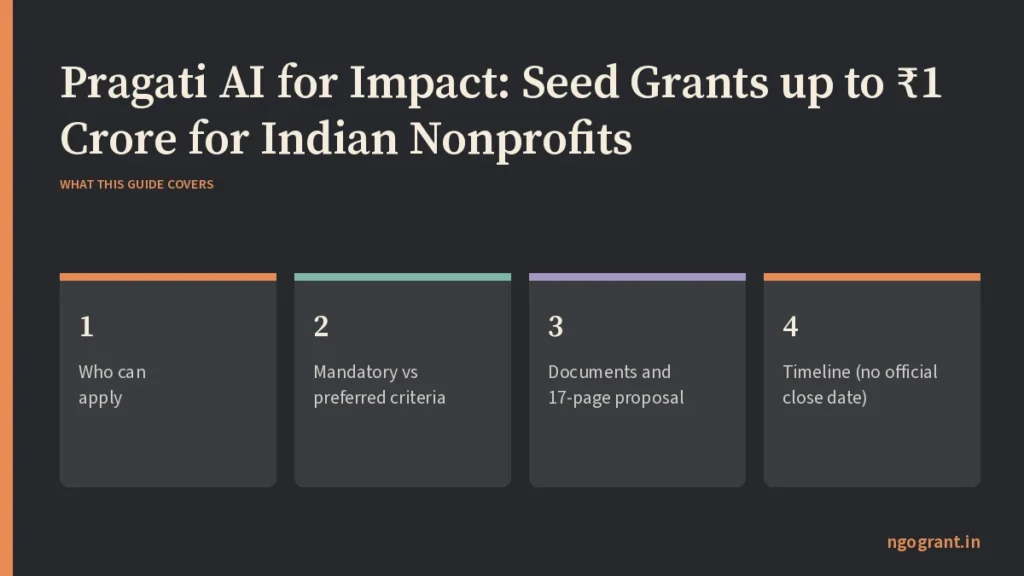
Short answer: the^delta is accepting applications to the seed cohort of Pragati AI for Impact, a programme in which Meta is the technology collaborator. Selected organisations can receive a seed grant of up to ₹1 crore, plus technology mentorship, peer learning, independent monitoring and sessions on responsible AI, to build and pilot a non-commercial AI solution. It is open to India-registered Trusts and Section 8 companies, anywhere in the country, that already have a prototype, pilot or working AI use case and work directly with the people they serve. The official programme page and application form do not state a closing date or hour. Interviews are planned for January–February 2027, with agreement signing and grant disbursement in February–March 2027.
Official application form →Official programme page →Official grant proposal template →
Who this is for, and who should skip it
This seed round is for a registered Indian Trust or Section 8 company that already uses AI in its work, or can show a prototype that makes AI central to the work, and that works directly with programme participants. You need at least one full-time founder. The form asks you to submit 11 documents, including a detailed 17-page grant proposal, and suggests setting aside at least 10 days to write it.
It is not a fit if you are registered only as a Society (the official materials name Trust or Section 8 company), if you only train or support other NGOs and do not work with end participants, or if the solution is commercial. Applications to the later Scale and Evangelise stages are by invitation only; you cannot apply to those stages in this open round.
What you can receive
- Seed grant: up to ₹1 crore, to build and pilot a scalable AI solution. The programme timeline says 100% of the grant is disbursed to selected organisations in March 2027.
- Support: strategic and hands-on guidance from technology mentors; workshops, masterclasses and peer-learning sessions; visibility through convenings, demo days and media; and independent monitoring by a third-party agency.
- Responsible AI: awareness sessions on safe and ethical practice. The programme page says compliance with ethical guidelines rests with the grantee organisation.
- Later stages: a possible follow-on grant of up to ₹2 crore at the Scale stage, and a later Evangelise stage for wider adoption through government programmes and existing service systems. Progression is not automatic; each stage has its own selection process.
The official page does not say how many organisations will be selected in this round.
Eligibility: what is mandatory, and what the FAQ still lists as a threshold
The application form splits its criteria into mandatory and preferred. Mandatory items are: a registered Indian Trust or Section 8 company; 12A and 80G registrations valid until at least 31 March 2028; at least one full-time founder; direct work with end programme participants; a clear AI use case (an existing solution or at least a prototype that shows how AI is central to the work); and submission of the required documents, including the 17-page proposal. Supported solutions must be non-commercial. The form prefers organisations that make their work open, shareable or open-source.
The programme FAQ, on the same official page, still lists two further items as “threshold eligibility” for the seed, scale and evangelise grants: the organisation should be 1–10 years old, and it should have an annual budget of at least ₹1 crore. The application form treats both of those as preferred, not mandatory, and it asks for your date of incorporation and for funds raised in FY 2025–26. If you are older than 10 years, or your budget is below ₹1 crore, you can still complete the form, but you should read the FAQ and, if needed, ask the organiser at pragati@thedelta.org.in before you invest the time.
The form also asks whether you were or are part of the^delta or The/Nudge incubator or accelerator. The current FAQ does not say that this waives the age line.
Sectors and geography
The programme page says Meta’s AI for Impact initiative supports work on livelihoods, skilling, healthcare, agriculture and education, and that the programme aims to support AI-driven nonprofit solutions across India. The form does not restrict applications to particular States or Union Territories. It asks you to choose up to two intervention sectors from: education and children; health and safety; employability, skilling and entrepreneurship; enabling ecosystem; agriculture, climate and food; financial inclusion; or another sector you specify. It also asks whether the work aligns with certain Schedule VII activities under the Companies Act, 2013, and offers “None of the above” as an answer, so that alignment is not itself a stated eligibility test.
Deadline and timeline
Applications to the seed cohort opened in November 2026, and the official application form is open. Neither the programme page, the application form nor the official proposal template states a closing date or a closing hour. Shortlisted applicants go through up to three rounds of interviews in January–February 2027. Selected organisations are notified by email. Agreement signing and grant disbursement begin in February–March 2027. The funded cohort is planned for April 2027 to March 2028.
Because the window can close without a date on the page, do not leave the 17-page proposal to the last minute, and re-check the official programme page and the application form before you submit.
What to submit
Apply only through the official form. The form and the proposal template ask for these uploads:
- Pitch deck or latest corporate presentation (up to 10 MB).
- Grant proposal, using the official 17-page template (up to 5 MB). Complete it offline and upload it with the form.
- Theory of Change diagram (up to 1 MB).
- A demonstration video of the AI solution, maximum 30 seconds.
- 12A certificate valid until at least FY 2027–28, or your renewal application; if you expect a delay, include a note from the Income Tax Department in the same PDF (up to 1 MB).
- 80G certificate on the same basis (up to 1 MB).
- PAN card (up to 1 MB).
- CSR-1 registration certificate (up to 1 MB).
- Audited financial statements for FY 2025–26 (up to 5 MB).
- Latest annual report, FY 2025–26 (up to 5 MB).
- A third-party assessment report, if you have one (optional, up to 1 MB).
The proposal template also asks for FCRA status if you have it, and it says project-specific intellectual property must be owned by the nonprofit. If the grant is foreign contribution, an Indian NGO generally needs FCRA registration or prior permission before it can receive the money; confirm the source of funds with the organiser if you are shortlisted.
The proposal is long. If you want a structure for the budget tables and the 15-month plan (January 2027 to March 2028) before you transfer them into the official template, our NGO Project Proposal and Budget Pack can help you organise the figures. Use the official template for the version you upload.
How selection works
Shortlisted applicants have up to three rounds of interviews in January–February 2027. The official page does not describe the interview panel in more detail. Selected organisations are told by email, then move to agreement signing and disbursement. The proposal template says information in the form may also be used in later stages of evaluation.
Common mistakes to avoid
- Starting the 17-page proposal late, on the assumption that a closing date will be posted with plenty of notice. None is posted now.
- Applying as a Society, or as an organisation that only builds the capacity of other nonprofits.
- Submitting without a prototype, pilot or other working AI use case.
- Uploading 12A or 80G certificates that expire before 31 March 2028, without a renewal application or an Income Tax Department note.
- Pitching a commercial product, or work that is not owned by the nonprofit.
For queries, the organiser gives pragati@thedelta.org.in. Also see our 12A certificate guide if you need to check how long your registration runs.
Frequently asked questions
Can a Society apply?
The official programme FAQ and the application form both say a registered Indian non-profit that is a Trust or a Section 8 company. Society is not listed. If you are registered only as a Society, write to pragati@thedelta.org.in before you spend time on the 17-page proposal.
Is an annual budget of ₹1 crore required?
The programme FAQ lists an annual budget of at least ₹1 crore as threshold eligibility. The application form lists “annual budget of ₹1 crore or more” as a preferred criterion, not a mandatory one, and asks you to enter funds raised in FY 2025–26 in crore. If your budget is below ₹1 crore, you can still apply on the form, but you should read the FAQ and, if needed, ask the organiser.
Must the organisation be under 10 years old?
The FAQ says applicants should be 1–10 years old. The form lists “organisations under 10 years of age” as preferred, not mandatory, and asks for your date of incorporation. The form also asks whether you were or are part of the^delta or The/Nudge incubator or accelerator; the current FAQ does not say that this waives the age line.
Is there a closing date?
The official programme page, the application form and the grant-proposal template do not state a closing date or hour. The page says applications to the seed cohort open in November 2026, with interviews in January–February 2027. Because the window can close without a published date, start the proposal early and re-check the official page before you submit.
Do I need 12A, 80G and CSR-1?
Yes, as documents. The form’s mandatory list asks for 12A and 80G registrations valid until at least 31 March 2028. The upload fields also accept a renewal application, and, if you expect a delay, a note from the Income Tax Department in the same PDF. CSR-1 registration is a required upload, as are your PAN, FY 2025–26 audited financial statements and latest annual report. Our 12A certificate guide covers how the 12A certificate works.
Is this a CSR grant?
We have not independently established that this is a statutory CSR grant. the^delta runs the programme; Meta is named as technology collaborator through its AI for Impact initiative. The form asks about alignment with certain Schedule VII activities and requires a CSR-1 certificate, but that is not the same as a confirmed CSR funding route. Treat it as a competitive programme grant unless the organiser tells you otherwise.
Browse the funding opportunities directory for other open calls.
Last verified 18 November 2026 (IST, Asia/Calcutta) against the official Pragati programme page, the official application form and the official grant-proposal template. Selection is competitive and never guaranteed. the^delta mentions no application fee. NGOGrant does not award these grants or charge approval fees. Apply only through the official form, not an intermediary.
Important: NGOGrant.in does not award or guarantee grants. Free information and official links are always free. Any fees are only for documentation / proposal preparation help — never for “sanctioning” a grant. Beware anyone who takes money to guarantee funding.