NGOGrant guide
SIDBI Innovation Challenge Fund: Up to ₹1 Crore for Makhana Solutions (closed)
Closed: applications for this call closed on 20 November 2026 at 6:00 PM IST. No extension was shown on SIDBI’s official SICF page when we checked on 20 November 2026 (about 6:25 PM IST). This article stays up for reference; the details below are as they stood before the deadline.
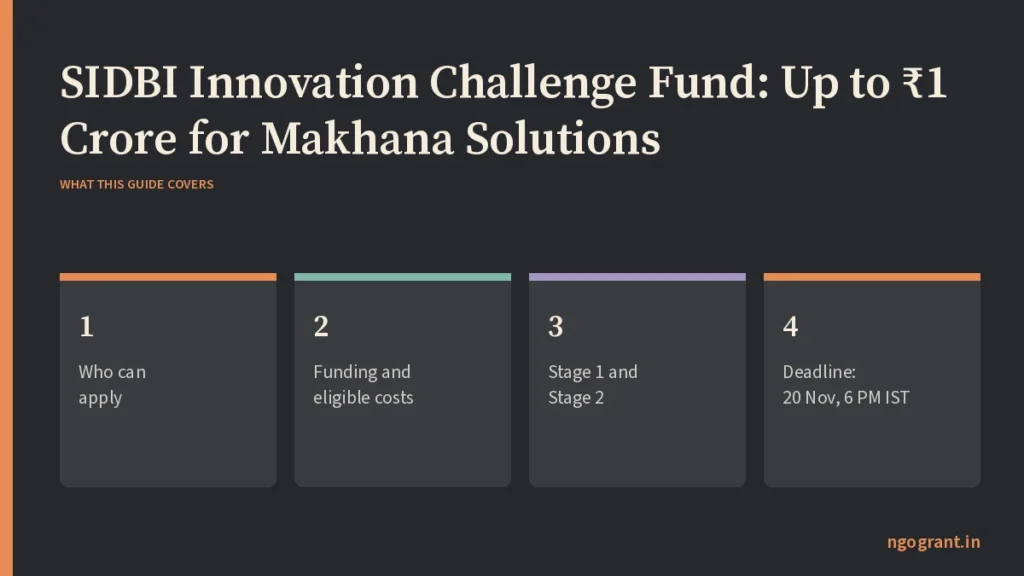
GRANT-136 · Government development-finance challenge fund · Agriculture: makhana cultivation and primary processing · All India (Bihar experience preferred) · Not CSR
Short answer: SIDBI’s Innovation Challenge Fund took applications for its second cohort, on the theme “Driving Innovation Across the Makhana Cultivation Cycle”. It offers fund support of up to ₹1 crore per project to scale up a practical solution that is already tested in the field, anywhere from seed and sowing to harvesting, collection, popping and primary post-harvest handling. Registered Societies, Trusts and Section 8 companies with real agricultural expertise can apply, as can DPIIT-registered agri-startups and research institutions. Applications closed on 20 November 2026 at 6:00 PM IST.
Official SIDBI online application →Official SICF page →SICF Guidelines 2026 (PDF) →
Who this suits, and who should not apply
This is for an organisation that has already done the hard part: built or adapted a tool, machine, process or cultivation practice for makhana and used it with farmers in real ponds or fields. A farmer-producer support NGO in north Bihar with a pond-harvesting device, an agri-tech startup with an affordable popping machine, or a research institute with a tested seed-germination method could all fit.
It is not for concept-stage ideas or solutions that still have to be developed from scratch. It is also not for flavouring, packaging or marketing after popping, or for topping up a project that is already funded. The deadline has now passed.
What SIDBI offers
- Fund support: up to ₹100 lakh per project, under the category “scale-up / replicable interventions”. The final amount depends on approved scope, deliverables, beneficiary potential and value for money.
- Co-sharing bonus: if you bring at least 5% of the fund from your own or other sources, SIDBI may consider up to 25% more than ₹100 lakh. The same section also says an individual project cost may not exceed ₹100 lakh, so confirm with SIDBI before you plan above ₹1 crore.
- Payment: milestone-linked tranches, released after verified deliverables.
- Timeframe: 12 months of implementation and up to 3 months of monitoring and handholding, 15 months in total.
- Minimum reach: at least 250 beneficiaries in the makhana value chain, with preference for more.
Eligibility
- Eligible entities: DPIIT-registered agri-startups; registered agricultural, academic and research institutions, including incubators, with demonstrated makhana solutions; and registered non-profits (Society, Trust or Section 8 company) with strong technical skills in agriculture and proven makhana solutions.
- Prior experience of a similar intervention under real field conditions. SIDBI prefers applicants who have worked in Bihar, and solutions tested or validated by an accredited laboratory or scientific body.
- Evidence of the problem and the expected benefit: research, field data or documented farmer feedback.
- A written constitution (bye-laws, trust deed, or memorandum and articles), end-to-end implementation capacity, financial controls and a suitable team. All consortium members, technology partners and subcontractors must be disclosed.
- Not eligible: entities that are blacklisted, declared defaulters or fraud by any recognised agency, or have a bad track record with a donor.
What the money can and cannot pay for
The budget can cover project-specific tools, machinery and equipment (purchase, fabrication, adaptation, installation and field deployment), mobilisation, training, coordination, travel, boarding and lodging, and indirect costs. Rent and electricity are allowed only for a training centre.
It cannot cover land, buildings, vehicles, computers, office furniture or IT equipment, debt repayment, depreciation, office rent and electricity, items already funded elsewhere, or work duplicating something done in the last six months. Part-funding, gap-filling and extensions of existing projects are not allowed. If you need a structure for a milestone-wise budget, our NGO project budget guide is a quick reference.
How to apply
- Register on SIDBI’s official online application with a working mobile number (an OTP is sent to it). The application must be filled using the same number.
- Stage 1, shortlisting application: personal details, entity details and seven thematic questions, marked out of 100: experience (15), problem and solution (15), innovation and readiness (20), implementation plan (15), cost, beneficiary coverage and adoption (15), expected outcomes (10), and sustainability and scale-up (10). Most answers have a 500-word limit (600 for innovation). Only fully filled applications received on time are evaluated.
- Stage 2, by invitation: shortlisted applicants are emailed from scf@sidbi.in to send a detailed proposal and give a presentation to an expert panel, online or in person in Lucknow.
SIDBI judges proposals on activity, budget and change; on how inclusive, innovative and impactful they are; and on feasibility, sustainability and measurable impact for makhana farmers and workers. Cost per beneficiary carries weight.
What applicants were advised before the deadline
- Register early on 20 November. Government portals slow down near a deadline, and anything after 6:00 PM IST is rejected.
- Answer the seven thematic questions offline first, within the word limits, then paste them in.
- Give numbers: farmers covered so far, reduction in labour or drudgery, yield or income change, and cost per beneficiary.
- Do not chase SIDBI for a status update. The guidelines treat status queries and lobbying as grounds for disqualification.
- Add scf@sidbi.in to your email contacts so the Stage 2 invitation does not land in spam.
This listing is based on SIDBI’s own SICF page and its SICF Guidelines 2026. Our box check could not load the application login page past the portal’s browser verification, so open it early and confirm it works on your connection.
Frequently asked questions
Can an NGO apply?
Yes. The official guidelines list registered non-profit organisations, meaning Societies, Trusts and Section 8 companies, alongside DPIIT-registered agri-startups and registered agricultural, academic and research institutions, including incubators. An NGO needs strong technical skills in agriculture and a proven solution in makhana cultivation, not just a good idea.
Does the project have to be in Bihar?
The guidelines do not limit the project to one State, and applicants from anywhere in India can apply. But Bihar produces most of India’s makhana, and SIDBI says it will prefer applicants who have implemented projects in Bihar.
Is ₹1 crore the maximum?
Up to ₹100 lakh (₹1 crore) per project may be considered, and the final amount depends on scope, beneficiaries and value for money. If you bring in at least 5% of the fund from your own or other money, SIDBI may consider up to 25% more on top of ₹100 lakh, at its discretion. The guidelines also say an individual project cost may not exceed ₹100 lakh, so ask SIDBI how the two lines fit before you budget above ₹1 crore.
Is this a grant or a loan?
The guidelines call it “fund support”, released in milestone-linked tranches after verified deliverables. They do not describe it as a loan or set out repayment, but they also do not use the word grant. Confirm the exact terms in the agreement if you are selected.
What was the last date to apply?
20 November 2026 at 6:00 PM IST, through SIDBI’s official online application. Late applications were rejected. No extension was shown on SIDBI’s official page when we checked on 20 November 2026.
Can I ask SIDBI about my application status?
No. The guidelines say canvassing, lobbying or queries about shortlisting or status lead to disqualification. Shortlisted applicants are contacted by email from scf@sidbi.in.
See this call’s entry in our closed-calls archive, and browse the funding directory for open calls.
Closed 20 November 2026; last verified 20 November 2026 (IST, Asia/Calcutta) against SIDBI’s official SICF microsite page (linked from sidbi.in) and the official SICF Guidelines 2026. Selection was at SIDBI’s discretion and never guaranteed. SIDBI mentioned no application fee. NGOGrant does not award this fund or charge approval fees.
Important: NGOGrant.in does not award or guarantee grants. Free information and official links are always free. Any fees are only for documentation / proposal preparation help — never for “sanctioning” a grant. Beware anyone who takes money to guarantee funding.