Which NGO Registration Do I Need? Trust vs Society vs Section 8 Tool
Choose a public charitable trust if a few trustees will manage a fund or property, a society if seven or more members will elect the governing body, and a Section 8 company if you want a board, company-law filings and MCA registration. Answer the five questions below to see which structure to examine first.
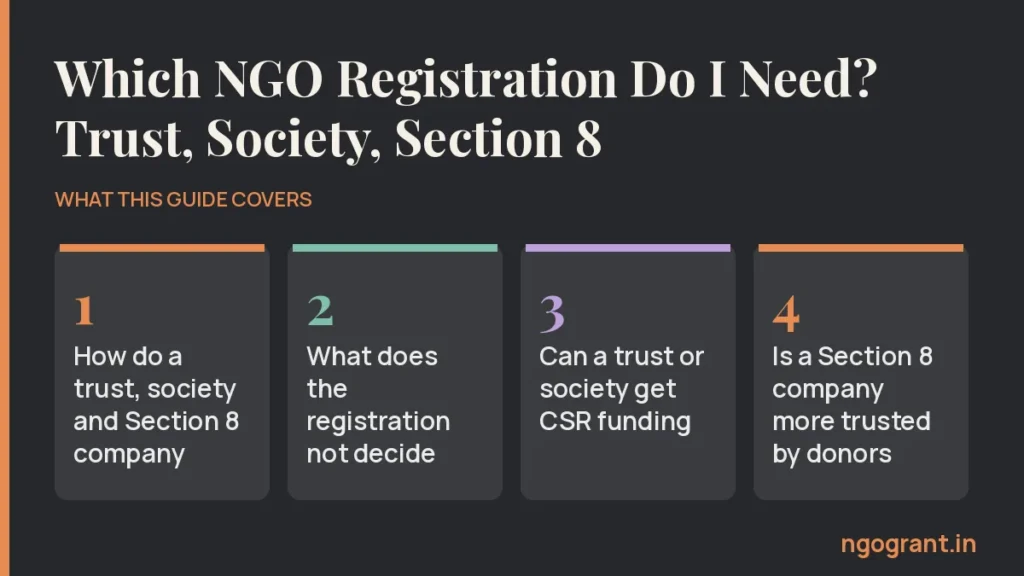
This free tool is for founders in India deciding how to register a new NGO. It gives neutral, rule-based guidance from your answers; it does not collect or store anything you click.
Which NGO registration do I need? Take the five-question check
How do a trust, society and Section 8 company compare?
| Question | Public charitable trust | Society | Section 8 company |
|---|---|---|---|
| Law it is registered under | State or UT public trust law (or registration of the trust deed) | Societies Registration Act, 1860 or State society law | Companies Act, 2013, section 8 |
| Who registers it | State registrar or Charity Commissioner, as the State provides | State Registrar of Societies | Ministry of Corporate Affairs (SPICe+) |
| Minimum founders | As the trust deed and State law provide | Seven or more persons (section 1 of the 1860 Act; some State laws differ) | At least two directors and two members for a private Section 8 company |
| How decisions are made | Trustees under the trust deed | Members elect a governing body under the rules | Board of directors and members |
| Yearly filings beyond income tax | State filings where the State law requires | Annual list of governing body or returns where the State law requires | AGM, AOC-4 and MGT-7 or MGT-7A with MCA |
| CSR eligibility (rule 4(1)) | Yes, if registered and holding 12A and 80G status, plus CSR-1 | Yes, same conditions | Yes, same conditions |
What does the registration not decide?
Registration only creates the organisation. Tax exemption and donor deduction (12A and 80G, now sections 332 and 354), NGO Darpan, CSR-1 and FCRA are separate applications for all three structures. Read society vs trust vs Section 8 company for the full comparison, and NGO registration cost for fees. If a society is your choice, Societies Registration Act 1860: key sections explains what the Act requires.
For a walk-through of the whole starting process, see NGO registration in India: how to start. If you want the Darpan, 12A/80G, FCRA and annual-compliance kits together, see the NGO Registration & Compliance Bundle. It helps you prepare the files; it does not register the organisation or obtain any approval.
Which NGO registration: common questions
Which NGO registration is best in India: trust, society or Section 8?
None is best for everyone. A trust suits a small group of trustees managing a fund or property, a society suits a membership body that elects its leaders, and a Section 8 company suits a board-run organisation ready for company-law filings. All three can get 12A/80G, CSR-1 and FCRA.
How many members are needed to register a society?
The Societies Registration Act, 1860 requires seven or more persons. Some States have their own society laws with different rules, so check the law of your State.
How many people are needed for a Section 8 company?
A private Section 8 company needs at least two directors and two members, and the same two people can be both. It is registered with the Ministry of Corporate Affairs through SPICe+.
Can a trust or society get CSR funding?
Yes. Under rule 4(1) of the Companies (CSR Policy) Rules, 2014, a registered public trust, a registered society and a Section 8 company can all implement CSR projects if they have 12A and 80G status and CSR-1 registration.
Is a Section 8 company more trusted by donors?
Not automatically. Funders look at governance, accounts, track record and registrations such as 12A, 80G and CSR-1. A Section 8 company has more formal company-law filings, which some institutional funders find familiar.
Official sources
- Societies Registration Act, 1860 (India Code)
- Companies Act, 2013, sections 3, 8 and 149 (India Code)
- MCA: SPICe+ FAQs
- MCA: CSR FAQs
NGOGrant.in is an independent information platform published by LendLink Tech Private Limited (CIN U74999NL2017PTC013422). It is not a government portal and does not issue registrations, approvals or grants. General information only, not legal advice.